




Social Studies and Science Block Made Easy


Do you find it challenging to fit Science and Social Studies into an already full school day?
You are not alone. Between math, reading, writing, and everything else that happens in a classroom, it can be hard to give these subjects the time and attention they deserve.
I have found that the answer is not trying to squeeze a little bit of everything into every day.
Instead, I like to keep Science and Social Studies simple and predictable. I plan units in blocks, teach one subject at a time, and use the same basic lesson structure each time.
Once the structure is in place, planning becomes much easier.
1. Plan in Blocks, Not Week by Week
Batch Units
One of the things that has made planning easier for me is batching my units.
Rather than switching between Science and Social Studies every week, I teach one subject for several weeks and then move into the other.
This gives me time to settle into a unit and lets students spend enough time exploring a topic without constantly switching gears.
Connect With Other Subjects and the World Around You
When I plan the year, I think about how my units fit together and what is happening throughout the year.
For example, I begin my Grade 3 Social Studies year with Rights of a Child. It fits naturally at the beginning of the school year as students are building relationships, learning how our classroom community works, and thinking about their rights and responsibilities.
As the year progresses, I move into topics connected to land, resources, and how people interact with the land.
I use the same approach with Science. I look at how the units can flow through the year and where I can make natural connections with the seasons, other subjects, and the world around us.
For example, I teach my Plants unit while agriculture and growing are happening in Saskatchewan. Students can see the learning happening around them, which makes the science feel much more meaningful.
Your curriculum and sequence may look different, but the idea is the same. When you plan your year, look for natural connections between your units, the seasons, your curriculum, and your students' world.
Then, when it is time to teach a unit, you can focus on the part that matters most: the daily lesson.
2. Use the Same Simple Lesson Structure
This is where Science and Social Studies can become much easier to plan.
You do not need a completely different lesson format for every topic.
I use approximately 40 minutes and follow the same basic structure:
Minilesson + Hook → Activity → Reflection

That is it.
The content changes from unit to unit, but the structure stays the same.

Minilesson + Hook - 10 minutes
Start by getting students curious.
This might be a wonder question, photograph, short video, object, map, demonstration, or something that makes students stop and think.
This is one of the most important parts of the lesson. Before asking students to complete an activity, I want them to understand what they are learning and, even better, want to know more about it.
Once I have their attention, I teach the main concept or understanding for the lesson. I try to keep this focused. One clear concept connected to the curriculum expectation is enough.
The goal is not to fill the first ten minutes with information. It is to give students enough background and direction that they are ready to explore the idea themselves.

Activity - 20–25 minutes
Now students get to do something with what they have learned.
This is the most important part, so I like to make the learning as active as possible.
Depending on the topic, students might:
investigate a question
conduct an experiment
complete a hands-on activity
work with a map or diagram
sort and classify information
play a review game
complete a simulation
work with task cards
create a model
record observations
discuss and explain their thinking
The activity does not need to be complicated. In fact, I often find that the simplest activities work beautifully when they have a clear purpose.
Students have just learned something new. Now they have a chance to use it, talk about it, question it, and make it their own.

Reflection - 5–10 minutes
I always want to leave a little time at the end of the lesson to bring the learning together.
This does not need to be another big activity. It might be a quick partner share, a class discussion, or a simple exit ticket.
Ask:
What did we learn today?
What are you still wondering?
How does this connect to something we already know?
Sometimes one good question is enough.
This quick reflection also gives you valuable information. You can see who understood the idea, who is still working through it, and where you might need to spend a little more time in the next lesson.
3. Plan the Unit, Then Plan the Lessons
Once I have my year mapped out, I do not try to plan every Science and Social Studies lesson for the entire year at once.
Instead, I focus on the unit I am about to teach.
First, I identify the big ideas students need to understand. Then I break those ideas into individual lessons.
Because I already have my lesson structure, I am not starting from scratch each time.
For each lesson, I simply ask:
What is the one thing I want students to learn today?
What will get them curious about it?
What can they do with that learning?
How will I know what they understood?
Those four questions give me the bones of my lesson.
Then I fill in the details.
It really can be that simple.
Keep It Simple
Science and Social Studies do not need to feel like two more subjects competing for space in your day.
When you have a plan for the year, teach your units in manageable blocks, and use a consistent lesson structure, the day-to-day planning becomes much easier.
Minilesson + Hook → Activity → Reflection
It is a simple structure, but it gives you plenty of room for experiments, inquiry, discussion, maps, projects, games, investigations, and all of the interesting things that make Science and Social Studies so much fun to teach.
You do not need to reinvent your lesson every day.
You just need a structure that works, and then you can fill it with learning.
See This in Action
This is the same approach I use when creating my own Science and Social Studies units.
Here are some of my resources if you would like to take a look.
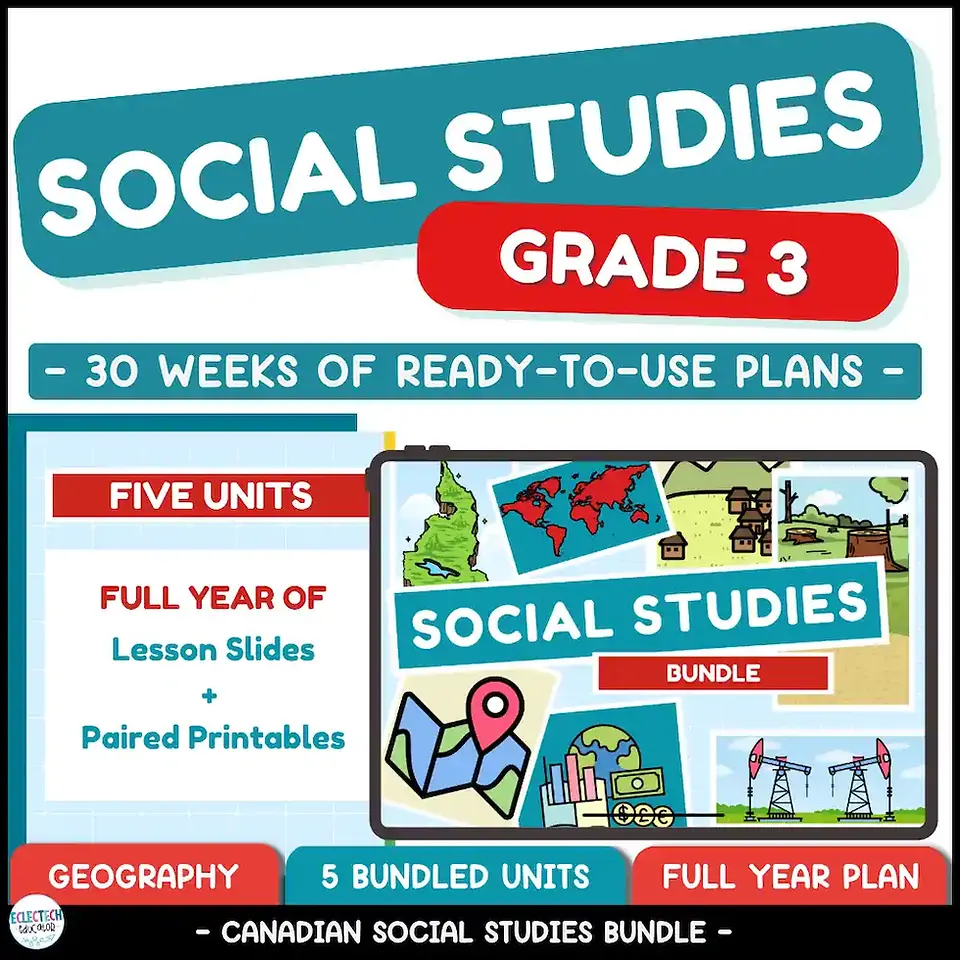
Social Studies Bundle Grade 3 
Social Studies Bundle Grade 4 
Social Studies Bundle Grade 5 
Science Bundle Grade 3 
Science Bundle Grade 4 
Science Bundle Grade 5


Comments