







How I Structure My Reading Block


One of the questions I get asked most often is, "What does your reading block actually look like?"
The answer is surprisingly simple.
Over the years, I have found that students thrive when they know exactly what to expect. Rather than changing the structure every day, I keep the routine consistent while the reading skills change throughout the year.
This predictable routine helps students build independence, stay engaged, and spend more time thinking deeply about what they read instead of wondering what comes next.
My reading block follows the same four-part structure every day. In my grade 3 classroom, this routine fits comfortably into a 45-minute literacy block, but it can easily be adjusted to fit your schedule. I also used this routine when I taught grade 2 and grade 4.
Minilesson ➡ Activity ➡ Reading Time ➡ Reflection
Each part has a clear purpose, making it easy for students to settle into learning while giving me the flexibility to meet the needs of my readers.

1. Minilesson
Time: Approximately 10 to 15 minutes
Every reading lesson begins with a focused minilesson.
Instead of trying to teach multiple comprehension strategies or reading skills at once, I introduce one specific reading focus. By narrowing the focus, students have the opportunity to learn the skill or strategy well before moving on to something new.
Depending on the lesson, I might use a picture book, a short passage, a mentor text, or our class novel. As we read together, I model my thinking aloud so students can hear how successful readers make predictions, infer meaning, ask questions, identify important information, and monitor their understanding.
The goal is not to finish the story. The goal is to teach one reading skill or strategy well.

2. Activity
Time: Approximately 15 to 20 minutes
After the minilesson, students immediately apply the new skill or strategy through a short, guided activity.
This step gives students the opportunity to practice the skill or strategy with support before they are expected to use it independently.
Activities vary throughout the year and might include:
Partner discussions
Graphic organizers
Short written responses
Sorting activities
Identifying text evidence
Collaborative comprehension tasks
These activities reinforce the day's learning while building students' confidence before they begin reading on their own.

3. Reading Time
Time: Approximately 15 to 20 minutes
Reading Time is the heart of the reading block. This is when students actively apply the strategy or comprehension skill introduced during the minilesson through authentic, purposeful reading.
This portion of the reading block is flexible and can be adapted to meet the needs of your classroom. Students may be reading independently, completing a reading response, working through a literacy task, participating in a literacy rotation, or reading with a partner. At the same time, you may choose to meet with individual students or small groups for targeted instruction, guided reading, or reading conferences.

If you choose to use literacy rotations, I recommend keeping them simple. Rather than asking students to move through several rotations in a single reading block, I prefer using one purposeful rotation each day. Fewer transitions mean more time spent reading, thinking, and responding to text, while also making classroom management much easier.
Although the activities may vary, the purpose remains the same. Students are actively reading while applying the strategy or comprehension skill introduced during the minilesson. Because the overall routine stays consistent, students quickly learn what is expected of them and become increasingly independent throughout the year.
I will be sharing a dedicated blog post that explains how I organize my R.E.A.D. rotations, including what each rotation looks like and how I use them to build independent readers.
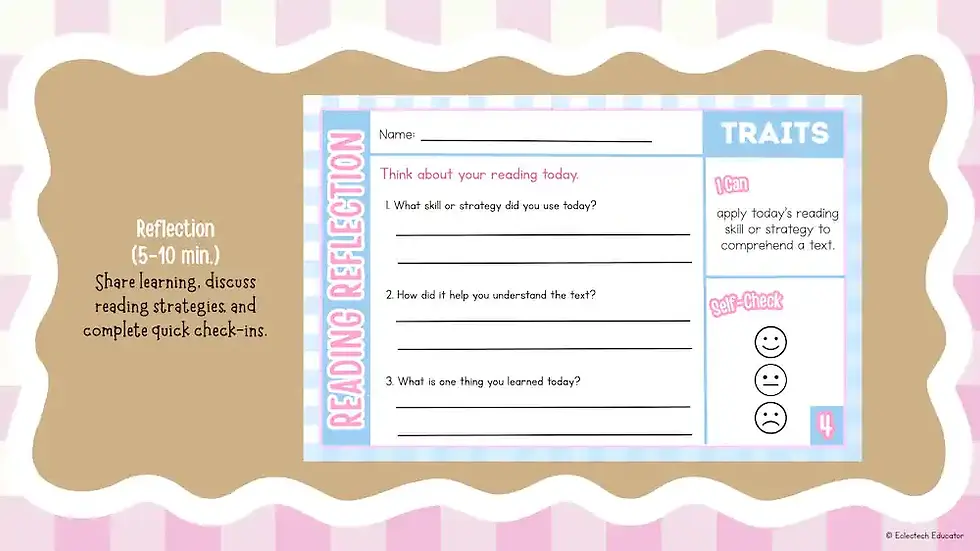
4. Reflection
Time: Approximately 5 to 10 minutes
Reflection is one of the most valuable parts of the reading block.
Before moving on to the next subject, students spend a few minutes thinking about what they learned and how they used the day's reading skill or strategy. It builds accountability, deepens understanding, and creates a classroom culture where all readers learn from one another.
Reflection might include:
Discussing how others applied the same skill or strategy in different ways
Sharing with a partner discoveries, questions, or challenges they encountered
Completing an exit slip
Writing in a reading journal
Responding to a discussion prompt
Explaining their thinking using evidence from the text
These quick reflections encourage students to become more thoughtful readers while giving me valuable formative assessment that helps guide future instruction.
Why This Routine Works
One of the biggest strengths of this reading block is its consistency.
Students always know what comes next. Instead of spending valuable instructional time explaining new procedures, we can focus on developing stronger reading skills and strategies.
Whether we are learning about making predictions, identifying theme, understanding character traits, making inferences, summarizing, or using context clues, the routine never changes.
That consistency builds confidence, independence, and stronger reading habits throughout the school year.
A Note About Daily Reading Routines
In addition to our reading block, we also have a short daily reading routine after lunch. This 10-minute block is focused on building a love of reading and giving students consistent time with books.
Some days, students participate in Read to Self, where they settle in with a self-selected novel and enjoy independent reading time.
Other days, we have Read to Us, where I read aloud from our classroom novel. This gives us the opportunity to enjoy a shared story, model fluent reading, build vocabulary, and have conversations about the text together.
While the reading block focuses on teaching and practising reading strategies, this daily routine is about developing confident readers who enjoy books.
Final Thoughts
A successful reading block does not need to be complicated.
By following a predictable routine of Minilesson ➡ Activity ➡ Reading Time ➡ Reflection, students know what to expect, become more independent, and have meaningful opportunities to practice new reading strategies every day.
The routine stays the same. The learning grows.
That simple consistency has made a tremendous difference in my classroom, and I hope it helps make your reading block feel a little easier too.


Comments